A Corporation Tax Return (CT600) is the form every UK limited company uses to report its taxable profit to HMRC and work out how much Corporation Tax it owes. You file one for each accounting period, which is normally a 12-month year. The CT600 filing deadline is 12 months after that period ends, but the tax has to be paid earlier, 9 months and 1 day after the period ends. Since 1 April 2026 you can only file through commercial software, and the fixed penalties for filing late have doubled to £200 and £400.
CT600 at a glance
| Question | Answer |
| What is it? | HMRC’s Company Tax Return, filed with your accounts and tax computation |
| Who files? | Limited companies and other bodies that pay Corporation Tax, including loss-making ones |
| Filing deadline | 12 months after the end of the accounting period |
| Payment deadline | 9 months and 1 day after the period ends (quarterly instalments for large companies) |
| Rates for 2026/27 | 19% up to £50,000 profit, 25% above £250,000, marginal relief in between |
| How to file | HMRC-recognised commercial software or an agent. HMRC’s free service closed on 31 March 2026 |
| Late filing penalty | £200 from day one, £400 in total after 3 months, then 10% of unpaid tax at 6 and 12 months |
| Records | Keep them for at least 6 years |
What is a CT600?
CT600 is HMRC’s name for the Company Tax Return. On it, the company states its turnover, its taxable profit for the period, the reliefs and allowances it is claiming and the Corporation Tax that results. HMRC uses it to check the tax your company has paid, or is about to pay.
The form never travels alone. A complete Company Tax Return has three parts:
- the CT600 form itself, plus any supplementary pages that apply
- the statutory accounts for the period
- the Corporation Tax computation, which shows how accounting profit was adjusted to reach taxable profit
Supplementary pages cover less common situations. The ones we file most often are CT600A for loans from the company to directors or shareholders, CT600C for group relief and CT600L for research and development claims.
CT600 vs CT603
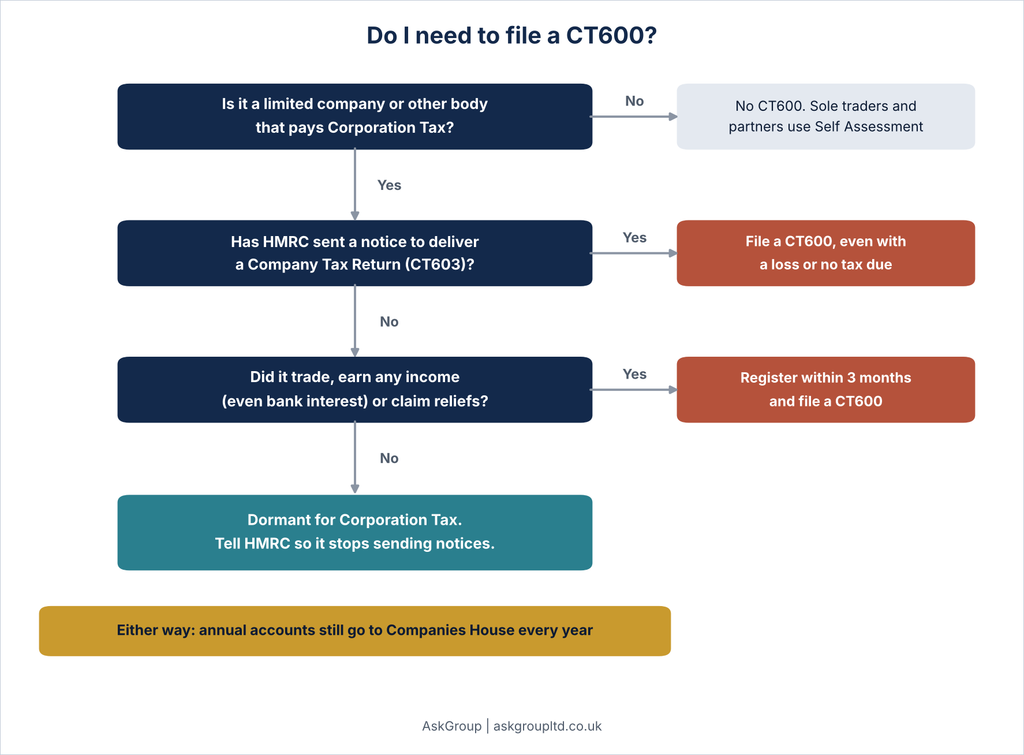
A CT603 is the notice to deliver a Company Tax Return that HMRC sends after your accounting period ends. The CT603 is the request and the CT600 is your reply. Plenty of directors file the letter away and forget it, but the formal deadline to file runs from that notice.
Who has to file a Company Tax Return in the UK?
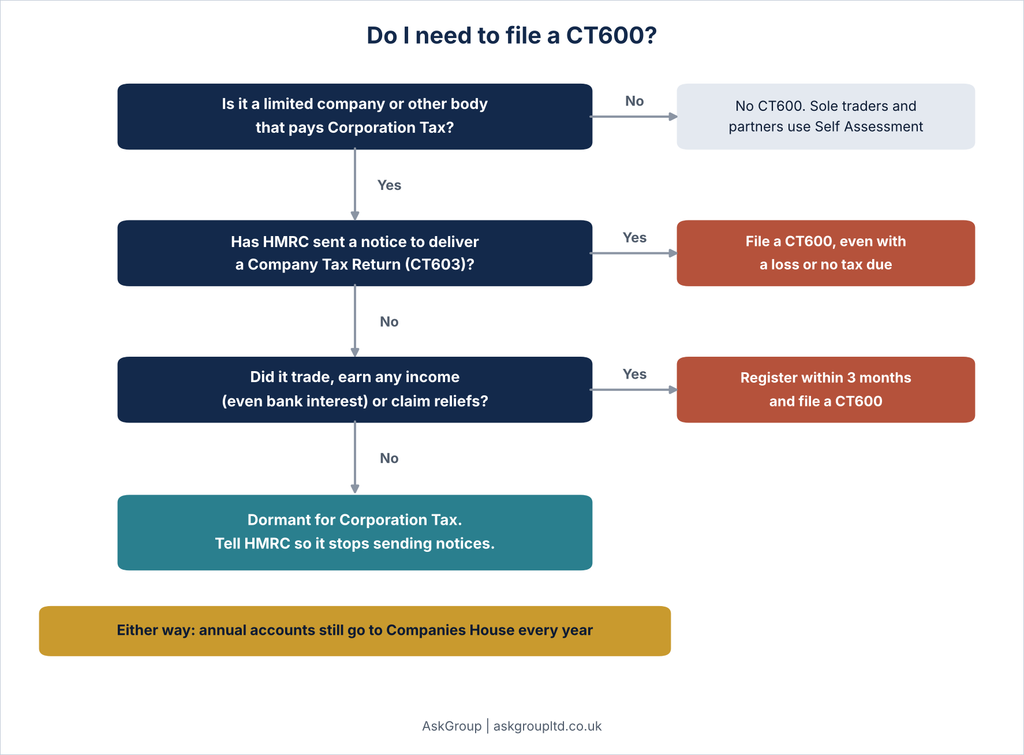
Every UK limited company files a CT600, and so do foreign companies with a UK branch or office and most clubs, co-operatives and unincorporated associations. Sole traders and partners don’t. They report business profits through Self Assessment, which has its own deadlines and penalties.
A new company has to register for Corporation Tax within 3 months of starting to do business. Buying, selling, advertising, renting premises or taking on staff all count, so that date often arrives sooner than directors expect.
Do I need to file a CT600 if my company made a loss?
Yes. Making a loss doesn’t remove the duty to file once HMRC has sent a notice, and the CT600 is how you claim the loss. A trading loss can be carried back against the previous year’s profits, which may produce a refund, or carried forward to reduce tax in later years. Skip the return and you give up the record of that relief, and you still collect late filing penalties even though there was no tax to pay.
Do I need to file a CT600 if my company is dormant?
Only if HMRC asks for one. HMRC treats a company as dormant for Corporation Tax when it isn’t trading and has no other income, so a few pounds of bank interest can be enough to make it active. If your company really is dormant, tell HMRC and it should stop sending notices to file. Any notice you have already received still needs a return, and dormant accounts still go to Companies House every year.
When must you file your CT600?
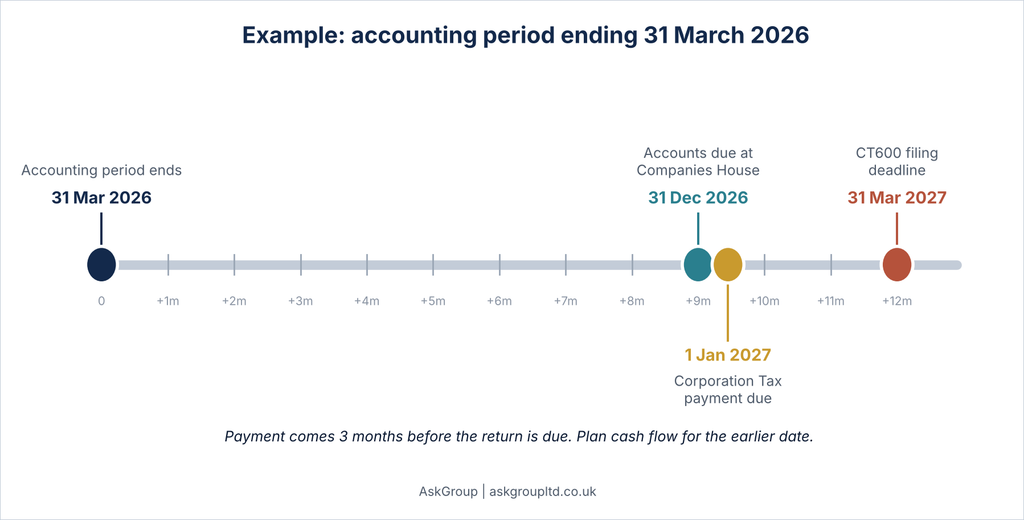
Your Corporation Tax return deadline is 12 months after the last day of the accounting period it covers. A company with a 31 March 2026 year end must file by 31 March 2027. That sounds generous. In practice it’s the last of three deadlines that come from the same year end, and the other two arrive first.
The Corporation Tax payment deadline
For most companies, the tax is due 9 months and 1 day after the period ends. The money leaves your account about three months before the return is due, so you need the final figure well before the CT600 filing deadline. HMRC charges late payment interest at 4 percentage points above Bank Rate. With Bank Rate held at 3.75%, that is currently 7.75% a year.
Companies with taxable profits above £1.5 million pay in quarterly instalments during and just after the period, and those above £20 million pay earlier still. Both limits are divided between associated companies, so a group can cross them before any one company looks large.
Key dates for common year ends
| Year end | Accounts to Companies House | Corporation Tax payment | CT600 filing deadline |
| 31 December 2025 | 30 September 2026 | 1 October 2026 | 31 December 2026 |
| 31 March 2026 | 31 December 2026 | 1 January 2027 | 31 March 2027 |
| 30 June 2026 | 31 March 2027 | 1 April 2027 | 30 June 2027 |
| 30 September 2026 | 30 June 2027 | 1 July 2027 | 30 September 2027 |
Accounting periods and your first CT600
A Corporation Tax accounting period can’t be longer than 12 months, even when your company accounts cover a longer stretch. This catches out a lot of first-year companies. Say a company incorporated on 15 January 2026 starts trading straight away and draws up its first accounts to 31 January 2027. Those 12.5-month accounts produce two CT600s: one for 15 January 2026 to 14 January 2027, and a second for the final 17 days. Each has its own payment date and its own filing date.
CT600 vs annual accounts at Companies House
Directors often assume that filing accounts at Companies House also deals with HMRC. It doesn’t. These are two filings to two different bodies, with different deadlines and different penalties.
| CT600 (HMRC) | Annual accounts (Companies House) | |
| Purpose | Reports and calculates Corporation Tax | Public record of the company’s finances |
| What you send | CT600, accounts and tax computation, tagged in iXBRL | Statutory accounts in the format your company size allows |
| Deadline | 12 months after the accounting period ends | 9 months after the year end (21 months from incorporation for first accounts) |
| Public? | No, it stays between you and HMRC | Yes, anyone can view them on the register |
| Late penalty | £200 upwards, plus tax-geared penalties | £150 to £1,500 for private companies, doubled if late two years running |
| Filing route | Commercial software or an agent | Software or paper now, software only from April 2028 |
Companies House penalties sit on a separate scale and are charged automatically. The accounts rules are changing too. In June 2026 Companies House confirmed that from 1 April 2028 accounts must be filed through software, small and micro companies will have to file a profit and loss account, and abridged accounts will no longer be an option.
Corporation Tax rates in the UK for 2026/27
The Corporation Tax rates haven’t changed since April 2023. What you pay depends on your taxable profit:
| Taxable profit (12-month period) | Rate |
| £0 to £50,000 | 19% small profits rate |
| £50,001 to £250,000 | 25% main rate, reduced by marginal relief |
| Over £250,000 | 25% main rate |
Marginal relief smooths the step between the two rates. For a 12-month period, it equals £250,000 minus your profits, multiplied by 3/200. On profits of £100,000, tax at 25% is £25,000, marginal relief is £150,000 x 3/200 = £2,250, and the bill comes to £22,750. That’s an effective rate of 22.75%.
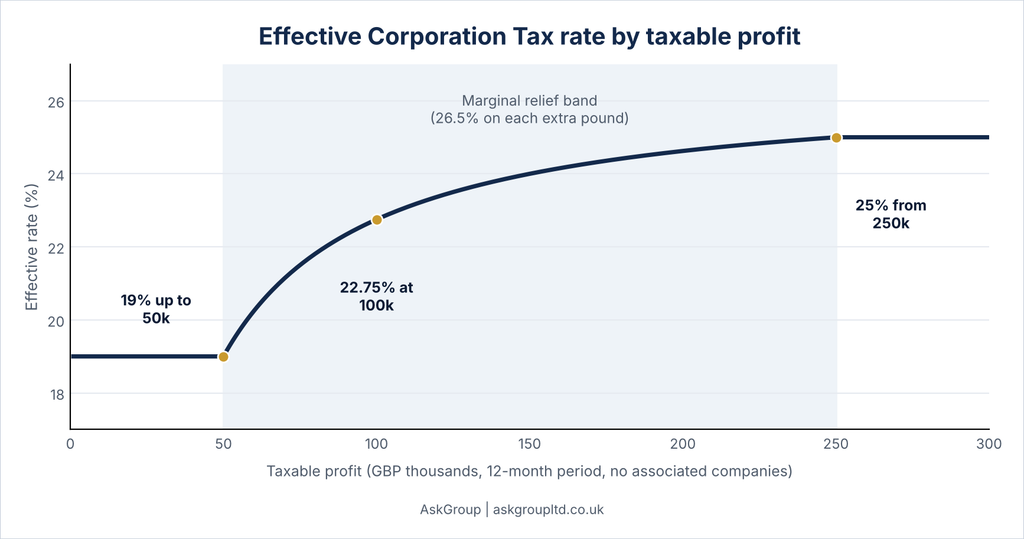
Inside the band, each extra pound of profit is taxed at 26.5%, higher than the main rate. For companies in that range, the timing of spending and pension contributions can make a noticeable difference, and our guide on how to reduce your tax bill legally covers the options.
Two details change the numbers. The £50,000 and £250,000 limits shrink for accounting periods shorter than 12 months, and they are divided by the number of associated companies. A director who controls two companies gets limits of £25,000 and £125,000 in each. If you run more than one company, our article on group companies explains how this plays out.
How to file a CT600 in 2026
The biggest change this year is the route. HMRC’s free Company Accounts and Tax Online service closed on 31 March 2026. Since 1 April 2026 every CT600 has to go through commercial software, and HMRC only accepts a paper return if you have a reasonable excuse or are filing in Welsh.
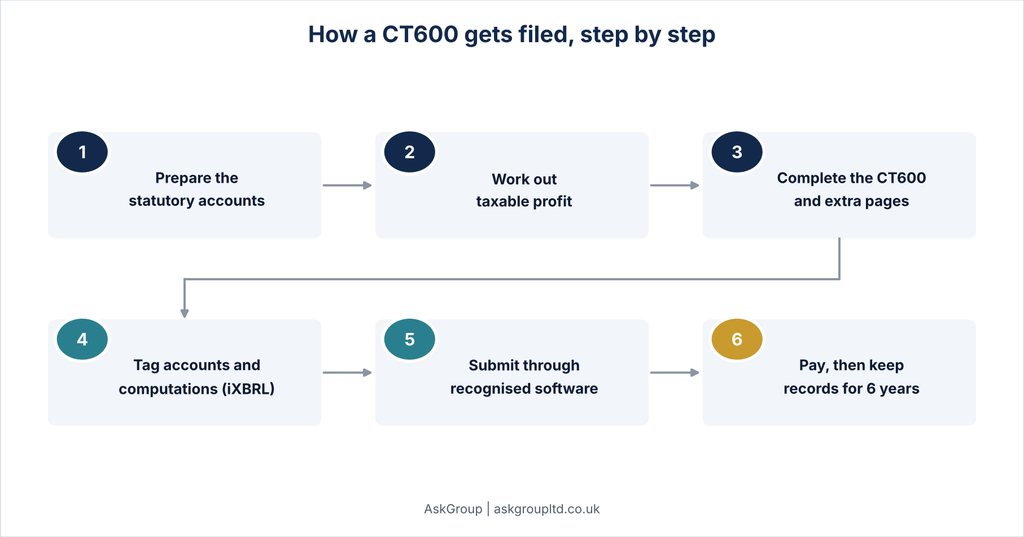
- Prepare the statutory accounts. They come straight from your bookkeeping, so tidy records speed up everything that follows. Our small business accounting checklist is a good place to start.
- Work out taxable profit. Start with accounting profit, add back costs HMRC doesn’t allow, such as depreciation and client entertaining, then deduct capital allowances and any losses brought forward.
- Complete the CT600 and any supplementary pages. The accounting period dates must match HMRC’s records exactly, because a mismatch is one of the most common reasons for a rejected return.
- Tag the accounts and computation in iXBRL. HMRC only accepts them in this machine-readable format, and good software does the tagging for you.
- Submit through HMRC-recognised software or an agent. You’ll need the company’s 10-digit Unique Taxpayer Reference and Government Gateway login, or an agent authorised to act for the company.
- Pay and keep records. The payment is usually due before you file, using the 17-character payment reference for that period. Keep records for at least 6 years, and if you spot a mistake, you can amend the return within 12 months of the filing deadline.
What to look for in CT600 software
Most bookkeeping packages can’t file a CT600 on their own, so check before you pay for anything. The software needs to file the CT600, accounts and computation together in iXBRL, cover the supplementary pages you use and apply marginal relief correctly when there are associated companies. Pick something that also files accounts with Companies House, since that becomes compulsory in 2028.
If you’d rather not run tax software yourself, a professional accountant files on your behalf using their own tools. Many firms now use AI-assisted accounting for the bookkeeping that feeds the return, which shortens the year-end process.
CT600 late filing penalties and interest
For returns with a filing date on or after 1 April 2026, the fixed late filing penalties doubled. This is how they build up:
| How late | Filing date before 1 April 2026 | Filing date on or after 1 April 2026 |
| 1 day | £100 | £200 |
| 3 months | Another £100 (£200 total) | Another £200 (£400 total) |
| 6 months | HMRC can estimate your tax and add 10% of the unpaid amount | Unchanged: 10% of unpaid tax |
| 12 months | Another 10% of unpaid tax | Unchanged: another 10% |
| Third late return in a row | £500, or £1,000 if over 3 months late | £1,000, or £2,000 if over 3 months late |
Here’s what that looks like in money. A company with a 31 March 2026 year end files its CT600 at the end of November 2027, eight months late, with £20,000 of tax still unpaid. It faces £400 in fixed penalties and a £2,000 tax-geared penalty. If the interest rate stays at 7.75%, around £1,400 of interest will have built up since 1 January 2027. That’s roughly £3,800 added to the bill for a return that could have gone in on time.
Penalties for errors are separate. If HMRC finds a careless mistake, it can charge up to 30% of the extra tax, rising to 100% where an error was deliberate and concealed. Our guides on common tax mistakes and what to do after a missed tax deadline explain how to limit the damage.
If you had a reasonable excuse, such as serious illness or a software failure outside your control, you can appeal. Do it within 30 days of the penalty notice and keep evidence of what happened.
Common CT600 mistakes we see
Most of the returns we’re asked to fix have gone wrong in the same few places:
- Directors work to the 12-month filing date and miss the 9-month payment date, so interest starts running.
- The accounting period is wrong, usually in the first year or after a change of year end.
- Marginal relief is claimed without counting associated companies, which understates the tax.
- CT600A is left out when a director’s loan account is overdrawn at the year end. Unless the loan is repaid within 9 months and 1 day, the company owes Section 455 tax at 33.75% of the balance.
- Client entertaining or depreciation is claimed as a deduction.
- A company that is dormant at Companies House is assumed to be dormant for HMRC too.
Nearly all of these start in the books, not on the form. Keeping financial records organised through the year and avoiding common bookkeeping mistakes makes year end far simpler. It also helps if HMRC ever opens an enquiry or investigation.
How AskGroup can help with your Company Tax Return
We prepare and file Company Tax Returns for limited companies across the UK from our office in Beaconsfield. Our ACCA and CIMA qualified team handles the statutory accounts, tax computation, CT600 and iXBRL tagging. We file with both HMRC and Companies House and tell you what to pay, and when, well before the 9-month payment date.
If you’re unsure about a deadline, a penalty letter or your first set of accounts, look at our tax services and accounting services, or book an online appointment with the team.
Prefer to talk it through? Call 02030 044 974 or contact AskGroup.
Frequently asked questions
What is a CT600 form?
It’s HMRC’s Company Tax Return. A limited company uses it to report taxable profit, claim reliefs and calculate its Corporation Tax for each accounting period. It is filed together with the company’s accounts and tax computation.
When is the CT600 filing deadline?
12 months after the end of the accounting period the return covers. For a year ending 31 March 2026, the deadline is 31 March 2027.
When do I have to pay Corporation Tax?
Usually 9 months and 1 day after the accounting period ends, so 1 January 2027 for a 31 March 2026 year end. Companies with profits above £1.5 million pay in quarterly instalments instead.
Do I need to file a CT600 if my company made a loss?
Yes, if HMRC has sent a notice to file. Filing is also how you claim the loss, so it can reduce tax in the previous year or in future years.
Do I need to file a CT600 if my company is dormant?
Only if HMRC sends a notice to deliver a return. Tell HMRC the company is dormant so it stops sending them. You still have to file dormant accounts at Companies House.
Can I still file a CT600 for free on HMRC’s website?
No. HMRC’s free online filing service closed on 31 March 2026. Returns now have to be filed through commercial software or by an agent such as an accountant.
What is the penalty for filing a CT600 late?
For returns due on or after 1 April 2026, it’s £200 from the first day and another £200 after 3 months. At 6 and 12 months late, HMRC adds 10% of any unpaid tax each time. A third late return in a row raises the fixed penalties to £1,000 each.
Is a CT600 the same as filing accounts with Companies House?
No. The CT600 goes to HMRC to work out your tax and stays private. Annual accounts go to Companies House, appear on the public register and have their own, earlier deadline.
Can I amend a CT600 after submitting it?
Yes. You can usually amend it within 12 months of the filing deadline, through your software or your accountant.